27 March 2026 | Peace and Security | The Independent International Commission of Inquiry on the Syrian Arab Republic, established by the UN Human Rights Council, published a new report on Friday revealing that the brutal violence that swept Syria’s southern Suwayda governorate last July killed more than 1,700 people and forced nearly 200,000 to flee their homes.
Suwayda is home to the largest concentration of Druze, a religious minority in Syria, and has deep historical and cultural ties to the Druze community in Israel.
After the sudden change in the situation in Syria in December 2024, Israel militarily occupied the buffer zone in the Golan Heights and surrounding areas, invoking “the exercise of the right to self-defence”, and unilaterally demanded that Suwayda and the two other southern Syrian governorates be “fully demilitarised”, barring Syrian government forces and other armed groups from entering or establishing a foothold in southern Syria.
In July 2025, as clashes between local Druze armed groups and rival Bedouin tribal forces escalated sharply, the Syrian transitional government deployed security and military forces to the city, while Israel launched a series of airstrikes under the pretext of “protecting the Druze”.
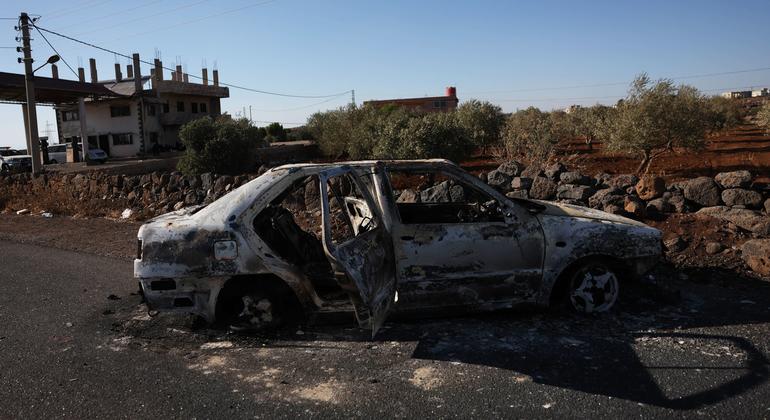
The report is based on 409 first-hand testimonies from survivors and eyewitnesses in affected communities, combined with extensive field visits to the worst-affected areas. After obtaining access from the Syrian Government, investigators found widespread destruction, especially in Druze villages, where tens of thousands of homes, shops and places of worship were burned.
The Commission documented widespread extrajudicial executions, torture, gender-based violence and the burning of homes, among other serious human rights violations, noting that these may amount to war crimes and, if confirmed by further investigation, could constitute crimes against humanity.
The report notes that the escalation began with inter-community tensions and unfolded in three waves of destructive violence: two targeting Druze civilians and one targeting Bedouin civilians.
The first and deadliest wave occurred from 14 to 16 July 2025 in western Suwayda and Suwayda city. During this period, government forces, supported by tribal armed groups, committed widespread violations of international humanitarian law and human rights law against Druze civilians, including killings, torture, arbitrary detention and looting.
The second wave began on 17 July. After Israeli airstrikes on Suwayda and Damascus and the withdrawal of government forces, Druze armed groups attacked Bedouin civilians, committing serious violations including killings, torture, arbitrary detention, forced displacement and looting, driving almost the entire Bedouin community out of the areas under their control.
The third and most destructive wave took place from 17 to 19 July, carried out by mobilised tribal armed groups in retaliation, again targeting Druze civilians.
The report notes that Israeli military intervention, as well as earlier actions aimed at weakening the government, undermining central authority and creating divisions, not only caused heavy casualties but also worsened instability, fuelled “treason” accusations against Druze community leaders and triggered further hate incitement online and retaliatory attacks against the entire community, deepening social divisions.
The Commission notes that each wave of violence was accompanied by sectarian insults against Druze and Bedouin civilians. Attacks on victims were clearly selective, based on religious identity, ethnicity, age and gender. As the violence escalated, the health system was overwhelmed and bodies piled up.
Communities have widely and strongly called for justice and for the repair of community relations. The Government has pledged accountability, granted the Commission access to Suwayda to conduct its investigation, and activated a national investigative mechanism. The mechanism’s latest briefing says 23 security and military personnel have been detained.
More than 1,700 killed
The investigation shows that the violence killed a total of 1,707 people. Among them, the Druze community lost 1,190 men, 99 women, 22 boys and 31 girls; the smaller Bedouin community lost 53 men, 9 women, 5 boys and 3 girls.
At the same time, at least 225 government personnel were killed in the clashes, many of them in Israeli airstrikes on Suwayda and Damascus between 14 and 16 July, with reports of additional tribal armed group casualties.
The report notes that many others were abducted, held hostage or unlawfully detained. Although most have since been found and released, about 100 Druze, 20 Bedouin and 30 government personnel remain unaccounted for.
The violence had a clear gendered dimension, with men and boys the main targets. Both the Druze and Bedouin communities also reported sexual violence, including rape, against women and girls. Of the nearly 200,000 displaced, about 155,000 have still not been able to return home, mainly from burned Druze villages. Almost the entire Bedouin community remains displaced, with many still living in rudimentary temporary shelter eight months later.
The report notes that during the July events hate and violence incitement rose sharply, fuelled by a flood of disinformation. False videos and claims about harm to foetuses and infants were widely circulated, including statements by Israeli government officials. These allegations have not been substantiated but have deepened mistrust between communities and complicated prospects for reconciliation.
The Commission calls for greater efforts to ensure comprehensive accountability, provide concrete guarantees and take measures to prevent recurrence, while strengthening confidence-building and reconciliation and adopting human-rights-compliant measures to address hate incitement and hate speech.
The report also urges the international community to provide multifaceted support to the Syrian Government to help implement the Commission’s recommendations, particularly on the rule of law and accountability, and calls on external actors, including Israel, to refrain from actions that may further destabilise the situation and endanger civilians.
Source: https://news.un.org/en/story/2026/03/1141841